
Costa Serena: NGS - PUS - NGS04A00
1 available date
Itinerary
Nagasaki, Japan
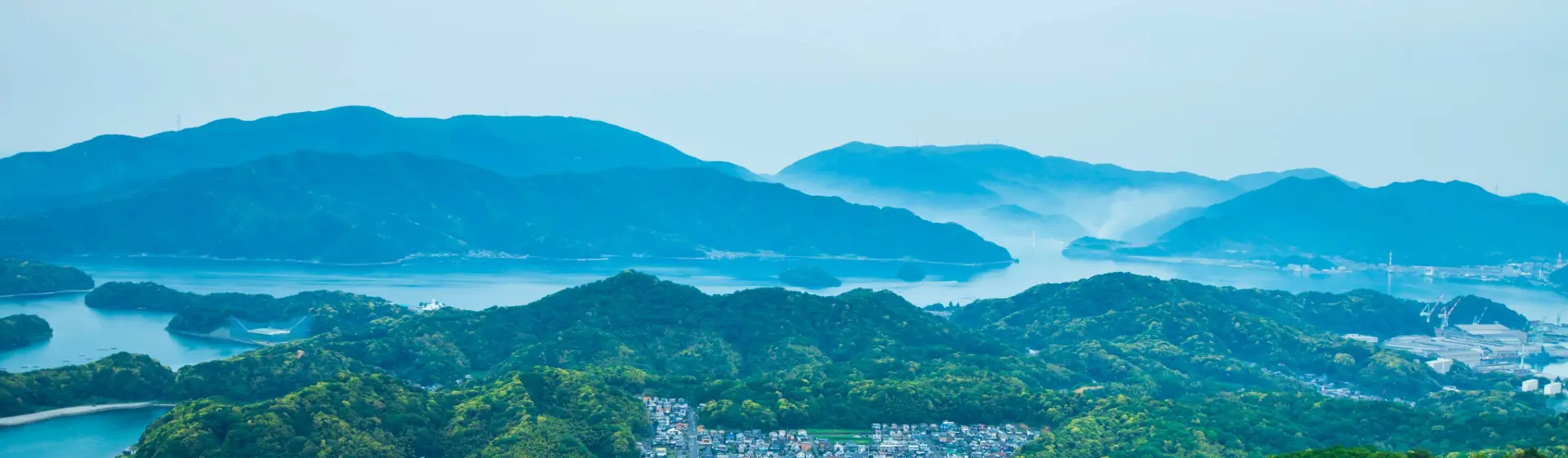
Nagasaki is the capital of the prefecture of the same name, situated on the island of Kyushu, the third largest island of the Japanese archipelago. The narrow strait of Shimonoseki separates it from Honshu. Kyushu is shaped like an irregular rectangle and features various areas of high ground reaching nearly 1800 meters including Mount Aso, the volcano.
The island's climate is characterized by abundant precipitation which encourages the growth of subtropical vegetation. The city of Nagasaki is in the middle of a long bay, the island's best natural port. The residential and commercial area of the city has been built on a small level area, whereas the metropolis of nearly half a million inhabitants extends along two main river valleys, divided by a rocky spur.
Nagasaki is famous throughout the world for having been the target of the American nuclear attack (together with Hiroshima) in August 1945, but its history goes much further back. Founded in the 16th century, to begin with Nagasaki was an insignificant port city. In 1549 the arrival of the Portuguese Jesuit missionary Francis Xavier gave rise to intense development involving western monks, Portuguese and Dutch merchants and local aristocrats. Little Nagasaki grew fast thanks to trade with China. Towards the end of the century, however, persecution of the Christian incomers started, and, on 5 February 1597, 26 of them were crucified. Oura Catholic church, built in 1865 by the French monk Bernard Petitjean, is dedicated to this massacre, and is therefore called the Church of the 26 Martyrs.
In 1614 Christianity was banned once and for all, and all priests were deported. It was only in the second half of the 19th century, when Nagasaki opened its port in1859, that Europeans returned in grand style. The construction of Oura Church is rightly considered the moment when Christianity was reborn in the whole of Japan. At the end of the century, under the Meiji government, the region began to develop substantial industries, with a special focus on ship-building. It was precisely the remarkable success of this development and the consequent industrial importance of Nagasaki which convinced the Americans to choose it as an atomic target. Today, Urakami, the centre of the explosion which happened at 11.02 on 9 August 1945, is a peaceful residential district.
It also houses the Atomic Bomb Museum which commemorates the tragic event. A black stone pillar in Hypocentre Park marks the exact site where the bomb ("Fat Man", as the American pilots who dropped it called it) exploded. The bomb, which was 2.34 metres long, 1.52 metres in diameter and weighed 4545 kilograms, exploded at a height of 550 metres. As Nagasaki was built in a hilly area, the number of deaths was lower than that caused by the first bomb on Hiroshima (6 August 1945). Approximately 40,000 people died at the time of the explosion and an estimated 25,000 were injured. Many thousands died subsequently as a result of the radiation. In the Peace Park, on a nearby hill, a statue nearly 10 metres high, made by the Japanese sculptor Seibou Kitamura, symbolizes a citizen of Nagasaki who wishes for peace and no more nuclear war. After the end of the Second World War, Nagasaki was rebuilt and is now very different from how it was before 1945. Temples and churches, including the Temple of Confucius and Urakami Cathedral, were restored and it is interesting to note that today Nagasaki has the highest percentage of Catholics of all the major Japanese cities.


Keelung (Taipei), Taiwan (China)
Keelung (sometimes called Jilong) is a major port city in the north-eastern part of Taiwan. It borders Taipei County and forms the Taipei-Keelung metropolitan area together with the City and County of Taipei.
Nicknamed the Rainy Port for its frequent rain and its important maritime role, the city is Taiwan's second largest seaport (after Kaohsiung). Keelung is currently administered as a provincial city of Taiwan Province in the Republic of China. It has been suggested that the name Keelung was derived from the local mountain whose shape resembles a rooster cage. However, it is more probable that the name was derived from the first inhabitants of the region, like the names of many other Taiwanese cities. Indeed, the area's earliest inhabitants were the Ketagalan people, and Ke-lâng was thus probably derived from Ketagalan.
The Ketagalan were a Taiwanese aboriginal tribe, whose first contact with the west was through the Spanish. From 1642 to 1668 Keelung came under Dutch control. The Dutch East India Company attacked the Spanish and, following a brief successful siege, conquered their Fort San Salvador at Santissima Trinidad. They reduced the size of the town and renamed it Fort Noort-Holland. The Dutch possessed three other fortifications in Keelung which included a small school with a Christian preacher. When the Ming Dynasty loyalist Koxinga (Cheng Ch'en-Kung) successfully attacked the Dutch in southern Taiwan, the troops stationed at the Keelung forts fled to a trading post in Japan.
However, they returned in 1663 and reoccupied and defended their former forts. Unfortunately, trade with China through Keelung did not achieve the hoped-for success, and in 1668 the Dutch left voluntarily. In 1863 the Qing Empire reopened Keelung as an international trading port and it played an important role in the economy of the region until 1885. However, from October 1884, following the outbreak of the Sino-French War, the town was occupied by the French under the command of Admiral Amédée Courbet. Keelung grew rapidly after Taiwan's passage to the Japanese in 1895 under the Treaty of Shimonoseki. It obtained the status of town in Keelung District in 1920 and was upgraded to a city of Taipei Prefecture in 1924.

Busan, Korea, Republic of
Busan, a bustling city of approximately 3.6 million residents, is located on the southeastern tip of the Korean peninsula.
The size of Busan is 765.64km² which is 0.8% of the whole land of the Korean Peninsula. The natural environment of Busan is a perfect example of harmony between mountains, rivers and sea. Its geography includes a coastline with superb beaches and scenic cliffs, mountains which provide excellent hiking and extraordinary views, and hot springs scattered throughout the city.
Busan enjoys four distinct seasons and a temperate climate that never gets too hot or too cold.
Busan is the second largest city in Korea. Its deep harbor and gentle tides have allowed it to grow into the largest container handling port in the country and the fifth largest in the world. In the coming years, capacity is set to grow further with the opening of the New Port. The city's natural endowments and rich history have resulted in Busan's increasing reputation as a world class city of tourism and culture, and it is also becoming renowned as an international convention destination.
Busan, a city of beautiful mountains, rivers and the sea, is also a important cultural city. With the Nakdong River bordering the city and superb natural scenery like Haeundae adding nationwide attraction, the city serves as a major nexus of cultural activities around the region. Also, Busan is the first international port city in Korea. Its location enables the city to serve as a main gateway for the Korean Peninsula and the entire Northeast Asian region.
Geographically, Busan has the Straits of Korea to its south; Ulsan to the north; Gimhae to the West. Cities that share almost the same latitude with Busan include Jinhae and Gwangju in Korea, as well as Tokyo, Jeongsen, Algiers and Oklahoma City abroad.
Busan is eight hours ahead of GMT. As for its geopolitical location, the city comes at the Southern tip of a strip that connects Asia, Siberia and Europe. It also serves as a main gateway to the Pacific Ocean.
This location places the city at the center of international sea transportation.
Busan is located at the southeastern most tip of the Korean peninsula and in the mid-latitude temperate zone, which has seasonal winds. It has four seasons: Spring, Summer, Fall and Winter. The annual average temperature is 15°C. The annual average precipitation is 2,397mm. Busan has strong winds compared to other areas in Korea. Spring begins in March and ends in late June. Cherry blossom trees bloom in late March. And the temperature is very comfortable in April, May and June. The rainy season at the end of June and July signals the beginning of the coming of the summer heat. The highest mean temperatures of around 32°C are at the end of July through mid-August. Fall is from early September through late-November.
The weather is nice and cool at this time because of the continental high atmospheric pressure. Winter starts by the end of November and continues until February. But Busan rarely has any snowfalls. The average winter temperature is 3.8°C. Tourists can enjoy Busan throughout all seasons because of the nice weather and beautiful scenery. In summer, the city is crowded with visitors who come to enjoy the beautiful beaches.
From its opening in 1876, the port city of Busan quickly developed into a hub of trade, commerce and industry. This development resulted in a rapid increase in its population, which had already reached 200,000 by 1936. A major leap in Busan's population came with the breakout of the Korean War, which resulted in an endless stream of people into the city. As a result, the population of Busan exceeded 1 million by the end of 1955. Another factor that spurred the population increase was the government policy for economic growth.
People from urban areas kept streaming into the city for jobs. By the end of 1994, there were approximately 4 million people who called Busan their home. Since 1995, the population has slowly begun to decrease. As of December 2006, Busan was home to 3,635,389 people.

Available cabins for Sat. 29.08. - Wed. 02.09.2026.


Costa Serena

The Myth Goes POP.
Deities no longer reside on Mount Olympus: now they live onboard. Costa Serena is back, completely renovated, featuring an elegant, surprising, ironic and magnetic soul.
Every space is a set and you are the protagonist.
Lights, colours and spectacular environments create a refined atmosphere with a POP twist, where you never take yourself too seriously.
Costa Serena doesn't follow myths but reinvents them. An ode to wonder that stays with you. Would you like to experience something different?
Featured activities